



跳转到主要内容
  • Published: June 9, 2025

  • Investor Knowledge   10分钟

    将军还是和棋?

    Making sense of a global economic shift

    分享

There is a major shift happening. A new global economic order that is shaping the economy to look very different from the recent past. For decades, the U.S. has been unrivalled in all three domains of public power: economic strength, technological prowess, and defense capabilities. However, with the ascendance of China, the world has entered a new bipolar era of power.

快速浏览

    • This article explores the emergence of a new global economic order marked by the rise of China as a peer competitor to the U.S. across economic, technological and military domains.
    • This economic change is resulting in a shift from unipolar dominance and free trade to a bipolar world defined by tariffs, industrial policy, and rising geopolitical tensions.
    • The Trump Administration has implemented a three-pronged “America first” strategy: aggressive tariff hikes, deregulation and pro-tech/growth policy, and efforts to weaken the overvalued U.S. Dollar.
    • Two future scenarios that may unfold include an optimistic one involving a pivot to growth policies and trade deals, and a pessimistic “America alone” outcome marked by isolation and global economic fragmentation.
    • For investors, diversification, a focus on quality assets, tech and infrastructure are expected to remain critical drivers in a volatile macro-economic environment.

Why is this happening?

This metamorphosis reflects China's expanding economic, technological, and military heft which is auspiciously challenging U.S. power. The post-war global order, long defined by U.S. dominance and free trade, is giving way to a multipolar world shaped by resurgent nationalism, protectionism, and geopolitical rivalry.
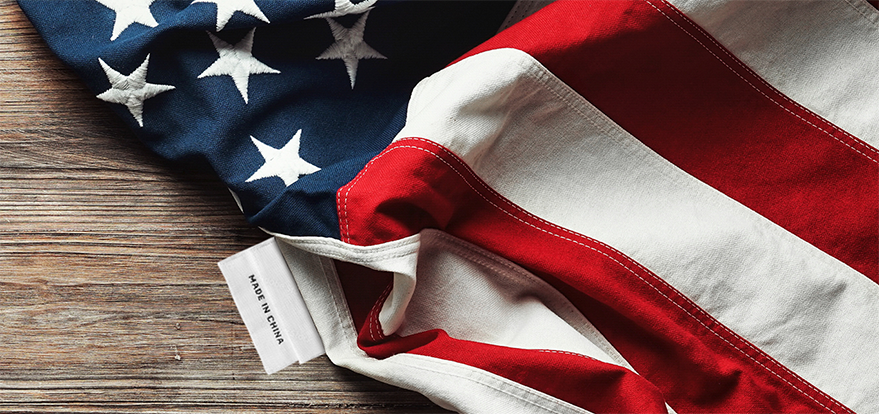
  • China's rise is strategic, not accidental. Its "Made in China 2025" initiative and sweeping industrial policies-subsidies, state-directed lending, and favourable tax treatments-have made it the global manufacturing superpower. Its share of global manufacturing has soared from 8% to 32%. In contrast, U.S. manufacturing and its labour share have sharply declined¹.

    This economic shift has generated major trade imbalances. China's trade surplus-now at $1.2 trillion-has created political backlash in the U.S., which faces a $1 trillion deficit². Deindustrialization, job losses, and rising inequality have fueled populist movements and political discontent. Technologically, China is surging. It produces 80% of the world's drones and 70% of batteries and dominates shipbuilding.

  • It's also closing the gap in artificial intelligence (AI), with Chinese models expected to rival top U.S. systems by 2026³. Militarily, China and Russia now account for 20% of global defense spending⁴-on par with the U.S. when adjusted for purchasing power.

    These shifts didn't happen overnight. The old global order's tipping point likely came around 2010, when state-based conflicts began to surge. Whether due to the 2008 Global Financial Crisis, Xi Jinping's rise in 2012, Trump's election in 2016, or the COVID-19 Pandemic in 2020, the old rules no longer apply and the slow moving new economic order has started to gain speed.

1 Source: World Bank. Dec. 16, 2024.
2 Source: Bloomberg Finance L.P Dec. 31, 2024.
3 Source: Polymarket. Dec. 31, 2024.
4 Source: World Bank. Dec 31, 2023.  

Grasping for power

Trump's response to China's rise and globalization's backlash has been fast and somewhat furious. His attempt to slow the global power shift consists of three key policies:

1. Tariffs and trade strategy 

  • Trump raised tariffs to levels not seen in over a century, driven by four motivations: unilateral control, revenue generation, trade leverage, and reshoring. While controversial, tariffs offer policy flexibility without congressional approval and create bargaining power in negotiations.

    The critical sectors the Trump Administration is trying to protect and grow include semiconductors, medical supplies, shipbuilding, and critical minerals. These are all areas where U.S. dependence on China is viewed as a national security risk. Semiconductor investment, for instance, has surged twelvefold since 2021 due to the Chips and Science Act⁵. Shipbuilding remains a glaring vulnerability: the U.S. accounts for just 0.1% of global production, compared to China's 54%⁶.

  • Against this backdrop, recent executive orders⁶ aim to rebuild capacity, particularly given the elevated risks in the Taiwan Strait. Reshoring is already happening, but mostly benefits capital, not labour. Moreover, manufacturing employment peaked in 2000 and is unlikely to return to historic highs due to automation. Investment is up, but jobs are concentrated in high-skill roles.

    As of now, trade negotiations are ongoing, and deals looks promising with key partners including Japan, India, South Korea. Talks with China are more fraught, but a narrow agreement—focused on energy, agriculture, and select non-tariff barriers—is still possible.

5 Source: Bloomberg Finance L.P Feb. 28, 2025.
6 Source: The White House, executive Orders.2025年4月9日。

2. Deregulation and pro-tech/growth policy 

Tariffs may dominate headlines, but the core of Trump Administrations, strategy is technological competitiveness. AI, robotics, and defense tech are national priorities. Three themes define this tech agenda:

    • The de-emphasis on AI safety: Regulatory rollbacks have shifted the focus from risk to innovation.
    • Infrastructure buildout: Investment in data centers, semiconductors, and energy (including nuclear) is accelerating.
    • Defense tech modernization: The Pentagon is pivoting to drones and AI-driven systems, favouring startups over legacy contractors. 
  • Trump aims to cut ten regulations for every new one. This deregulatory push spans energy, finance, construction, and tech-sectors vital for economic dynamism and national resilience. Previous administrations steadily added regulatory burdens; this one is intent on scaling them back.

3. Weakening the U.S. Dollar 

  • The Trump administration views the U.S. Dollar's overvaluation-estimated at 20% above its 1990-2020 mean-as a major driver of trade imbalances and industrial decline. The U.S Dollar's global reserve status boosts borrowing power but distorts trade and fuels deficits.

    Economists agree that discouraging foreign central banks from holding U.S. Treasuries would erode the Dollar's dominance. But such moves could also spike volatility and undermine deficit financing. The administration is exploring unilateral and multilateral strategies to reduce dollar demand while minimizing disruption.

Two possible scenarios that can unfold

While uncertainty remains on how the global economic transition will unfold in the months leading to next November’s house election, an optimistic and pessimistic scenario can still be conceptualized.

  • The optimistic scenario: A smooth policy pivot

    The optimistic scenario has potentially already begun since the Trump Administration (yearning to avoid the fate of his first term) lead with tariffs to get the bad news out of the way early on. This way the focus should have moved onto his pro-growth agenda well before next November, increasing the Republican Party's chances of keeping the house and maintaining control of Congress.

    After tariffs, the next focus would likely be negotiating trade deals, beginning with relatively straightforward countries, before moving onto the more challenging European Union (EU) and finally, the critical test with China. After negotiating, trade deals there could be a pivot towards promoting the pro-growth elements of the Trump Administration agenda, including tax cuts, pro-tech policies and deregulation. Finally, a controlled and purposeful weakening of the U.S. Dollar could be on the agenda, however this is still the subject of active debate within the administration, so its timing is less clear.

    This sequence maximizes market impact while minimizing electoral fallout. It reflects lessons from Trump's first term, when delayed tariff hikes hurt Republicans in the 2018 midterms.

  • The more pessimistic scenario: “America alone”

    This downside scenario is one in which "America first" devolves into "America alone". Such an outcome is plausible, especially as the U.S. ditches rules-based multilateralism, adopts populist nationalism, employs tariffs as a weapon and degrades the U.S. Dollar's global role.

    However, this is not the base case scenario as it is quite contrary to U.S. interests. The U.S. still needs allies, among other reasons to ensure the vibrancy of its tech sector. An isolated U.S. cannot win the mission critical AI race. It takes a global village, and the U.S. needs to attract talent and ideas from all corners. It also needs to ensure its AI innovations diffuse across the planet and define the new global standards.

    If this scenario unfolds, competing currency blocs emerge, volatility spikes, and global supply chains unravel-worse than the disruptions of the COVID-19 Pandemic. While not the base case, this "America alone" trajectory remains plausible if the U.S. abandons long-term alliances for short-term leverage.

Investor Implications

  • The optimistic "smooth policy pivot" scenario seems like the more likely of the two scenarios. Investors must be willing to adapt to a world defined by bipolar power dynamics, industrial policy resurgence, AI-driven disruption and a potential de-dollarization. The America First agenda, regardless of who holds office, is shifting U.S. policy toward national security, supply chain resilience, and strategic sectors

    The optimistic "smooth policy pivot" scenario seems like the more likely of the two scenarios. Investors must be willing to adapt to a world defined by bipolar power dynamics, industrial policy resurgence, AI-driven disruption and a potential de-dollarization. The America First agenda, regardless of who holds office, is shifting U.S. policy toward national security, supply chain resilience, and strategic sectors like semiconductors, energy, and defense. While tariffs matter, tech innovation is the long-term driver. Markets may benefit from tax cuts and deregulation in the second half of the year, but volatility will remain elevated. When looking over the long term, investors should consider:


  • like semiconductors, energy, and defense. While tariffs matter, tech innovation is the long-term driver. Markets may benefit from tax cuts and deregulation in the second half of the year, but volatility will remain elevated. When looking over the long term, investors should consider:

  • Diversification beyond U.S. mega-cap tech and the U.S. Dollar
  • Exposure to infrastructure, select commodities, and real estate
  • A strategic allocation to tech, the engine of future growth
  • Emphasis on quality equities with sustainable free cash flow.

The new global economic order is not just an economic story-it's a structural shift with profound investment implications. Navigating it requires foresight, flexibility, and global perspective.


本文所含信息由道明资产管理有限公司提供,仅供参考。信息出自我们认为可靠的来源。本信息并未提供财务、法律、税务或投资建议。具体的投资、税款或交易策略应根据每位投资者的目标和风险承受能力加以评估。

本文档中的部分陈述可能包含预测性的前瞻性陈述(“FLS”),其中包含“预计”、“预期”、“打算”、“认为”、“估计”和类似的前瞻性表述或其否定形式。前瞻性陈述基于当前对未来普遍的经济、政治、相关市场因素(例如利率和汇率、股票和资本市场)以及普遍经营环境的预计和预测,并假定不发生税法或其他法律或政府管制方面的任何变动或灾难事件。对于未来事件的预计和预测本身受无法预见的风险和不确定性的影响。此等预计和预测可能在未来并不准确。前瞻性陈述并非对未来表现的保证。实际发生的事件可能与前瞻性陈述明示或暗示的事件存在实质差异。包括上文所述各项因素在内的多个重要因素均可能造成这种背离。您不应在任何程度上依赖于前瞻性陈述。

道明资产管理有限公司 (TD Asset Management Inc.) 是道明银行 (The Toronto-Dominion Bank) 的全资拥有附属机构。

® TD标志和其他TD商标为道明银行或其子公司的产权。

(0525)

精选见解

  • 2025年6月3日

    收听Ingrid Macintosh与Kevin Hebner的对话,他们将深入探讨Kevin最新白皮书的内容,聚焦推动特朗普政策转变的关键因素,以及尘埃落定后投资者可能面临的前景。

  • 2025年5月13日

    大宗商品能否用于应对滞涨?

  • 2025年5月7日

    媒体报道的负面事件可能引发人们的情绪化反应,使他们忽视甚至质疑自己的投资策略。