


@TDAM_Canada
Market Perspectives 10分钟
Now that we know what "Liberation Day" has brought in terms of the magnitude and breadth of tariffs being unleashed on America's allies and trading partners, the unknown that remains is duration - how long will this economic tremor last? The longer these measures are in place, the more disruptive and destructive these policies will likely be on the global economy. Any "adjustments" made by corporations to re-align supply chains could take years, if not decades, to establish, while consumer patterns and behaviours may potentially be impacted for a generation.
In an environment of rapidly changing policies, reciprocal responses, and further "deals" to be negotiated, the TD Asset Management Inc., Asset Allocation Team ("we, "the team") have been preparing for a range of potential scenarios since early 2024, when the leading presidential candidates were finalized, and policies were announced. To be candid, there was hope for a more measured and prudent approach to any perceived trade imbalances, in hopes that those with "cooler heads" in the administration would prevail. Nevertheless, countries and markets have responded accordingly, and we are also monitoring in real time key developments that may shape returns and risks going forward.
The global market sell-off following U.S. President Donald Trump's tariff announcement on April 2 has rattled investors, with overseas markets and the S&P 500 Index all ending lower for the week. The S&P 500 Index is almost 20% below the mid-February all-time high (as at April 4). As at the time of writing, countermeasures to U.S. tariffs are emerging, with Canada announcing 25% tariffs on certain U.S. vehicles on April 3, while China will reportedly place an additional 34% tariff on all U.S. imports beginning Thursday April, 9. In Europe, French President Emmanuel Macron urged corporations to halt spending in the U.S. U.S. President Trump said he would consider reducing tariffs in return for countries offering something "phenomenal" to the U.S., though also suggested that sector tariffs on pharmaceuticals and semiconductors could be announced soon. Bond yields have fallen sharply lower, with both the U.S. and German 10-year nominal yields down around 15 basis points ("bps") to 3.88% and 2.50%, respectively. U.S. Federal Reserve Chair Jerome Powell spoke on Friday, and while not reacting with any monetary action, acknowledged the inflation threat of tariffs in the committee's forecasts. Market volatility has pushed the Volatility Index ("VIX") to 41, the highest since the growth scare in the summer of 2024, while U.S. high-yield credit spreads, a gauge of global risk premia, jumped by more than 50bps on April 3, the largest rise since March 2020.
Market Expectations and Outlook
Early estimates from economists highlight that the latest U.S. tariff measures could lower global Gross Domestic Product ("GDP") growth by at least 50bps, with a potential 100 to 150bps drag to U.S. GDP growth, a 100bps drag to China and a 40 to 60bps hit to Eurozone GDP growth. This comes against the backdrop of U.S. growth that has already started to weaken recently on the back of softening consumer spending. For global PMI, there is a potential 3 to 4 point downside risk due to tariffs. Three years of strong global growth left asset prices high, risk premia compressed, and earnings expectations elevated. Even before the latest tariff shock, the global growth outlook had started to darken, given the weakening run-rate of U.S. growth and the unexpected shift in U.S. policy focus from tax cuts to spending cuts. This had already led the MSCI World Index to decline by 6% from its all-time high and U.S. high-yield credit spreads, a good gauge of global risk premia, to rise by 80bps from a 17-year low.
Positioning
We continue to believe it is prudent to be on top of policy shifts from the current U.S. administration. As a result of this fluid policy dynamic, we maintain the ability to be tactical and nimble within TDAM investment portfolios in the current environment as we lean into alternative sources of diversification.
As we have outlined before, changes in investment regime have occurred more rapidly in the last decade than ever in recent history. As a result of the COVID-19 pandemic, hyperinflation, and now tariff tremours, we have shifted through several quadrants of growth/inflation. High degrees of macroeconomic uncertainty, especially concerning policy, can lead to periods of weakness for financial assets, but to varying degrees. Assets perform differently in diverse environments, and in the current climate of uncertainty, the best approach, in our view, is to maintain a diversified portfolio of non-correlated assets as your best defense.
Actively invest in a broader toolkit as non-traditional assets can mitigate risk/volatility
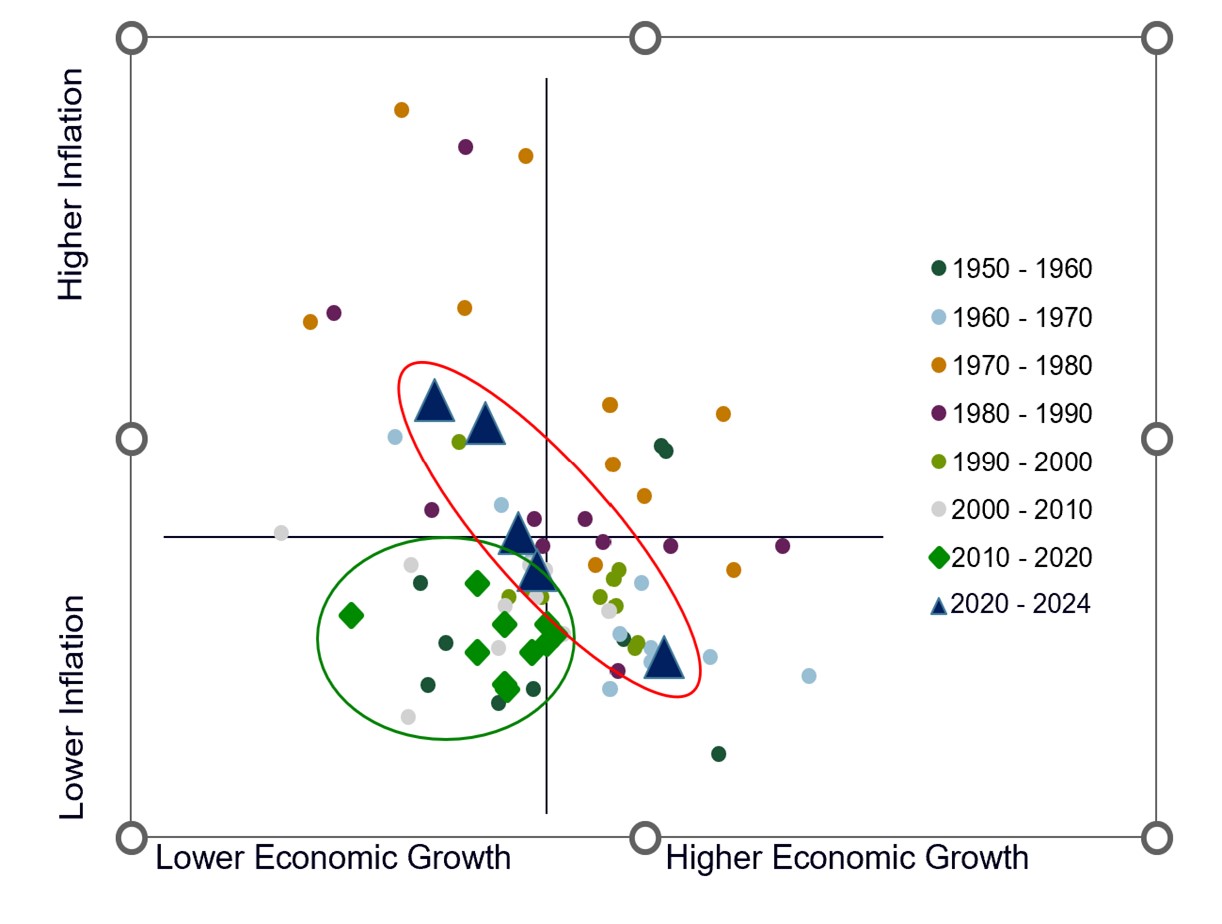
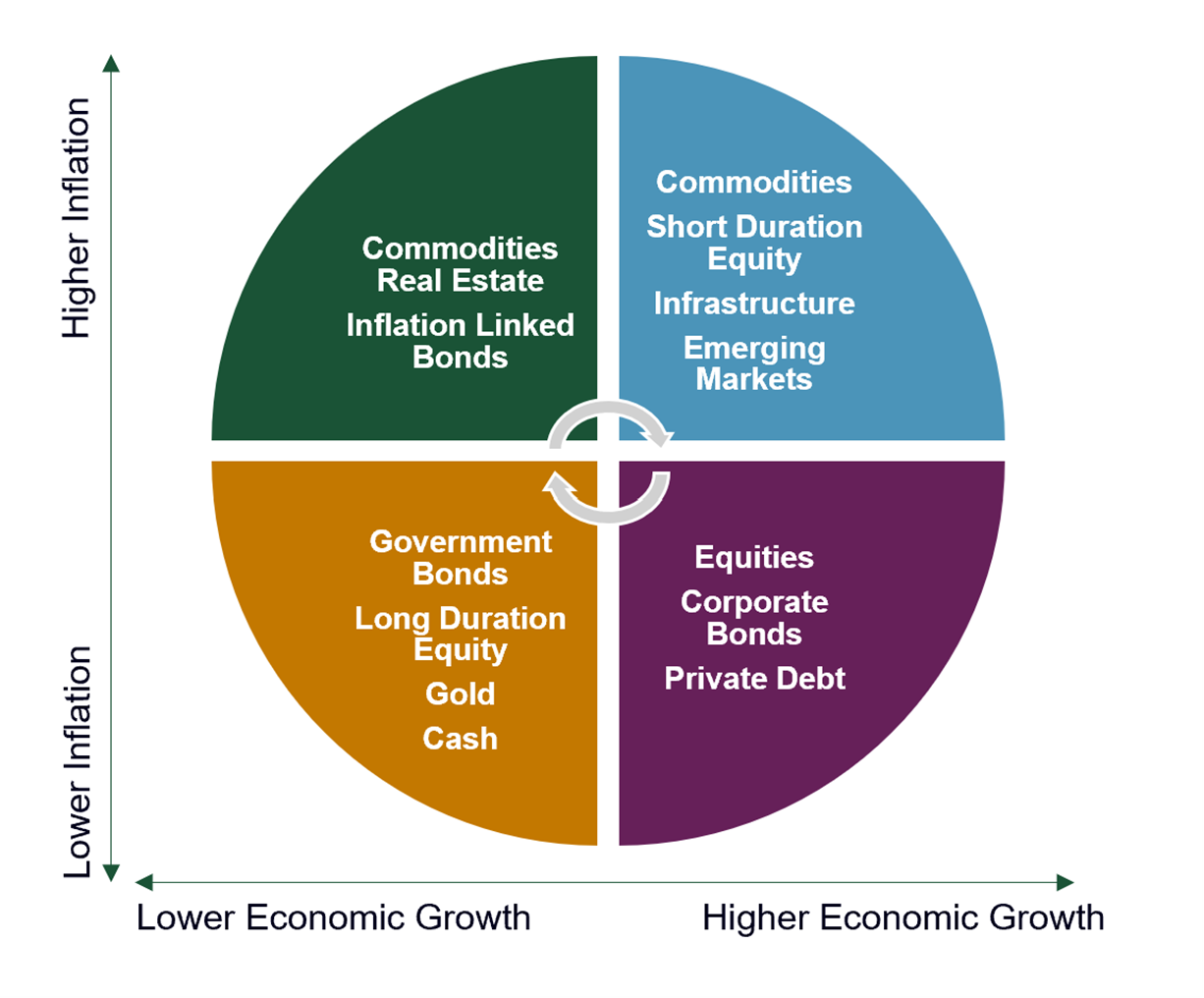
In this current environment, we have remained prudent in maximizing tactical flexibility and sources of diversification across all of our asset allocation portfolios, subject to distinct product/benchmark constraints. We have taken advantage of recent market volatility to add to positions where we feel there is relatively more risk-adjusted return potential and more stability. Here are some general examples of recent trades that have been implemented in anticipation of near-term uncertainty.
Fixed Income:
- Within the TD Fixed Income Pool, we are collecting higher yields than the benchmark through higher-quality credit and mortgages and are currently neutral to slight underweight duration
- We have continued to reduce longer-duration government bonds tactically.
- Re-allocated to high-quality corporate credit bonds, offering higher yields and limited downside risk.
- Added to private credit and mortgages for differentiated sources of income with low duration.
Equities:
- We have already continued to diversify away from the U.S. since the end of 2024, particularly decreasing weight in U.S. Technology sector stocks towards other regions and quality-factor equities.
- We increased to a neutral weighting towards Canadian banks by adding to Canadian Exchange Traded Funds (ETF) last fall. Canadian banks have performed strongly as fundamentals were better than analysts feared and benefitted from the flight to dividend payors. Canadian equity and economic performance have been improving, despite trade war headwinds. There is a possibility of improving U.S.-Canada relations and an investment in our nation's productivity and growth following a Canadian election, which could be positive for key Canadian sectors.
- We have been allocating more to targeted European ETFs due to rising tailwinds from fiscal spending, a strong Financials sector, low valuations, strong earnings, and a potential resolution to the Ukraine war. However, this reallocation has been measured, given Europe's high sensitivity to tariffs, and near-term investor sentiment has pushed valuations upwards quickly. We continue to believe that regional diversification is prudent as many investors globally are overly concentrated in the U.S.
- On a sector basis, we maintain a balanced allocation, with an overweight stance toward the Financials, Technology, Discretionary, Health Care and Industrials sectors.
- We believe the market may remain choppy and range-bound as policy uncertainty is digested. We will be pacing the deployment of remaining cash into equities as the market works through the current turmoil, particularly in quality names that may have been arbitrarily oversold along with the rest of the market.
Alternatives:
- We expect to increase our allocation to Infrastructure over the next 3 months as further capital calls for deals continue.
- We have increased the allocation to the commodity strategy and toward gold equities as the underlying commodity price has reflected a flight to safety.
本文所含信息由道明资产管理有限公司提供,仅供参考。信息出自我们认为可靠的来源。图表仅供解说之用,并不反映任何投资的未来价值或未来表现。本信息并未提供财务、法律、税务或投资建议。具体的投资、税款或交易策略应根据每位投资者的目标和风险承受能力加以评估。
进行互惠基金和/或交易所买卖基金(“ETF”)投资(统称“基金”)可能会产生相关的佣金、管理费和支出。进行互惠基金投资可能会产生相关的尾随佣金。交易所买卖基金单位在证券交易所按市场价格进行买卖,因此收益会因经纪人佣金的支付而减少。在进行基金投资之前,请参阅基金概况或摘要文件及招股章程,其中包含了详细的投资信息。所示回报率(货币市场基金除外)为互惠基金在所示期限内的历史复合总回报率,并已将单位价值变动及分红再投资计算在内。所显示的每种货币市场基金的回报率是指所示七天期限内的年化历史收益率,并在复利计算七天回报的基础上对有效收益率按年度计算所得,并不代表实际一年的回报率。指数回报不代表道明交易所买卖基金的回报。所显示的回报率并未考虑任何证券持有人的销售、赎回、佣金费用、分红或可选收费(如适用)或所得税,这些部分会降低回报。此类基金不在加拿大存款保险局 (Canada Deposit Insurance Corporation) 或任何其他政府存款保险机构的承保范围内,并且无担保或保险。互惠基金价值经常变动。货币市场基金的每单位资产净值不获保证会维持不变,您的投资本金亦不获保证全数归还。过往表现未必会重现。
本文档中的部分陈述可能包含预测性的前瞻性陈述(“FLS”),其中包含“预计”、“预期”、“打算”、“认为”、“估计”和类似的前瞻性表述或其否定形式。前瞻性陈述基于当前对未来普遍的经济、政治、相关市场因素(例如利率和汇率、股票和资本市场)以及普遍经营环境的预计和预测,并假定不发生税法或其他法律或政府管制方面的任何变动或灾难事件。对于未来事件的预计和预测本身受无法预见的风险和不确定性的影响。此等预计和预测可能在未来并不准确。前瞻性陈述并非对未来表现的保证。实际发生的事件可能与前瞻性陈述明示或暗示的事件存在实质差异。包括上文所述各项因素在内的多个重要因素均可能造成这种背离。您不应在任何程度上依赖于前瞻性陈述。
道明资产管理有限公司 (TD Asset Management Inc.) 是道明银行 (The Toronto-Dominion Bank) 的全资拥有附属机构。
® TD标志和其他TD商标为道明银行或其子公司的产权。


