

@TDAM_Canada
Investor knowledge 5 Minutes = Current Insights
Tariffs, interest rates, recessions, and inflation. These are all but a few thoughts people consider when trying to make sense of what is happening today and what could happen tomorrow in the economy - and by extension - financial markets. Distilling all the information related to these factors and trying to decide where and what to invest in can be a daunting task - even for professionals. This is why asset allocation portfolio solutions are hugely popular today. Investors hand over all the research and decision-making responsibilities to a team of investment professionals who divide up an investment portfolio across various asset classes, including stocks, bonds, and cash.
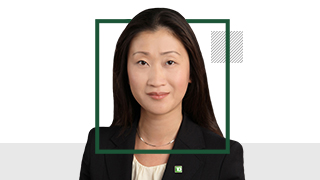
In an effort to get a better understanding on how the recent economic developments impact investments, particularly asset allocation strategies, we chatted with Jing Roy, Vice President & Director, Portfolio Manager, Asset Allocation at TD Asset Management Inc. (TDAM). Jing also provided some helpful insights on her career and experiences in the investment industry.
Getting to know Jing
Jing joined TDAM in 2014 and in her current role as a Portfolio Manager with the Multi-Asset Portfolio Management Team, she manages the global strategic, tactical and absolute return asset allocation strategies for the firm's managed solutions. 她在全球资产配置、投资组合构建、基本面股票分析和具有宏观经济叠加的跨资产衍生品方面经验丰富。她之前是基本股票团队的成员,负责全球材料行业。在加入公司之前,Jing是一位经验丰富的卖方股票研究分析师,涵盖材料、工业、电信和医疗保健行业。 Jing holds a B. Comm. from the University of Toronto, an MBA from Rotman School of Management at the University of Toronto and is a CFA charterholder.她也是一名商品交易经理。
Before we get into questions about equity markets, can you tell us a bit about your career path to where you are now?
Growing up, I wanted to be a developmental economist to find ways to improve people's lives, but life took a different turn. Instead, I became an equity research analyst covering Materials, Industrials, Telecom, Healthcare, and Special Situations. I also had a stint in Investment Banking. My experience gave me depth and breadth in equities, derivatives, and macro strategies. It also molded me into a strategic thinker who can create optionality and build resilience in portfolios to give investors a smoother investment experience in choppy markets. This helps investors stay invested so that they can buy their first house, enjoy their retirement, and leave a legacy to their loved ones. In a way, life has come full circle since I found the same sense of fulfilment in a different profession.
With everything that’s going on in the economy today, is there anything that changes your approach to asset allocation?
I would say that there are two new developments in the way we approach asset allocation. First, with the democratization of Alternative Assets, investors now have access to more tools to weather market uncertainties than ever before. Alternative Assets typically offer investors additional returns to compensate them for holding less liquid assets. This unique source of return helps the asset class generate returns that are less correlated with traditional equities and bonds. As a result, adding Alternative Assets to a traditional portfolio provides investors with the opportunity to improve overall portfolio returns without having to overreach for risk.
Second, investors are looking for more certainty around a stated investment outcome especially when they are faced with more financial constraints later in life. To achieve that without giving up too much return potential, investors need to access the right assets at the right time through active portfolio management. It also requires the use of derivatives to reduce the likelihood of large drawdowns and engineer a more favourable risk/reward profile. As a result, helping investors secure their long-term financial goals is more about generating consistent returns over time to stay ahead of inflation and head off longevity risk, and less about picking the stock with the highest return in any given year.
What would you say gives you the most optimism over the next 12 months and what worries you the most?
In the next twelve months, I am excited about the prospect of economic rejuvenation in Europe and Canada. The enormous uncertainty around trade and sovereignty brought by the Trump administration is galvanizing the political will for self-determination in the two regions. Europe, led by Germany, is ahead of Canada in tabling pro-growth policies to counter fraying Atlanticism¹. In Canada, policy platforms of both Conservative and Liberal parties look to boost productivity by removing regulatory barriers, reducing tax burden, and encouraging investments. This is a historic moment for Europe and Canada to rise up to the challenge. If successful, the two regions can deliver attractive equity returns in the next twelve months.
On the flip side, what worries me the most in the next twelve months is the Trump administration's attempt at reshaping domestic institutions and global economic order. The administration not only looks to extend executive power over independent federal agencies, it also demands financial relief from U.S. trading partners for providing a defense umbrella and reserve assets. A disorderly dollar devaluation would be a real challenge to risk assets globally.
What would be the most important thing you have learned about investing throughout your career?
Witnessing the Asian Financial Crisis and taking a front row seat during the Global Financial Crisis are formative investment experiences for me. I observed that elite investors tend to share three attributes. First, they are expert at pricing risk, sizing positions, and managing risk. Second, they ruthlessly challenge every assumption behind their investment thesis. Lastly, they are multidisciplinary and draw on knowledge from disparate fields to form insights and drive returns.
The good news is that investors do not need to be in that rarified group to invest and have a fair shot at financial security. To keep things simple, the key is to understand your return objectives and risk tolerance, curate a well-diversified portfolio, and stay invested for the long-term.
What keeps you busy when not focused on markets?
Besides investing, I love music and reading. I also love planning the most thrilling, outrageous escapades with my nine-year-old daughter.
¹Source: Bloomberg Finance L.P March 14, 2024.
本文所含信息由道明资产管理有限公司提供,仅供参考。信息出自我们认为可靠的来源。本信息并未提供财务、法律、税务或投资建议。具体的投资、税款或交易策略应根据每位投资者的目标和风险承受能力加以评估。
本文档中的部分陈述可能包含预测性的前瞻性陈述(“FLS”),其中包含“预计”、“预期”、“打算”、“认为”、“估计”和类似的前瞻性表述或其否定形式。前瞻性陈述基于当前对未来普遍的经济、政治、相关市场因素(例如利率和汇率、股票和资本市场)以及普遍经营环境的预计和预测,并假定不发生税法或其他法律或政府管制方面的任何变动或灾难事件。对于未来事件的预计和预测本身受无法预见的风险和不确定性的影响。此等预计和预测可能在未来并不准确。前瞻性陈述并非对未来表现的保证。实际发生的事件可能与前瞻性陈述明示或暗示的事件存在实质差异。包括上文所述各项因素在内的多个重要因素均可能造成这种背离。您不应在任何程度上依赖于前瞻性陈述。
道明资产管理有限公司 (TD Asset Management Inc.) 是道明银行 (The Toronto-Dominion Bank) 的全资拥有附属机构。
® TD标志和其他TD商标为道明银行或其子公司的产权。


