


@TDAM_Canada
Investor Knowledge + 5 Minutes = Current Insights
美国大选季再一次到来,不出意外的话,决胜选举将在两位人们异常熟悉的候选人之间展开 - 现任总统拜登,以及共和党推定提名人、作为挑战者的前任总统特朗普。这两位候选人均面临着较高的不支持率,并且在成为各自党派提名人选的道路上都有可能遇到绊脚石,而两极分化严重的选民则要通过投票在二者中选出一位获胜者。这些因素使得此次大选注定成为近年来最吸引眼球的大选之一。
What's everyone thinking?
According to a recent Pew poll, 26% of American's have an unfavourable opinion of both candidates, with this view especially prominent among voters aged 18-29 (41%) and those without strong party affiliation (averaging 36%) ¹. Part of the reason is increased polarization, but the age of the candidates is also a factor. ²
A March survey by Piper Sandler says that 87% of investors expect a close presidential election and 82% predict a divided government³. Moreover, the contest will feel familiar, as it is a repeat of 2020. This is unusual as Biden vs. Trump 2024 is only the 7th rematch in U.S. history (out of 60 elections) and the first for almost everyone voting this year (the last rematch was 1956, Eisenhower vs Stevenson).
Much ado about nothing?
Before we dig into the investment implications from the election, its important to note that, historically, markets largely have been unaffected by U.S Presidential election outcomes.
The direction of the market, no matter the outcome, is more likely to be driven by fundamental factors like interest rates and corporate earnings. Sure, the possibility for short term market gyrations based on headlines and political rhetoric can be expected, but longer term, asset values and returns are largely driven by fundamentals.
What's in store for markets?
What could a Democratic or Republican party win mean for the macroeconomy and markets? Our thoughts in this blog will emphasize potential policy changes under a second Trump administration, mainly because a Biden re-election would, to a considerable extent, maintain the status quo.
Both candidates are pursuing policies that are inflationary. This includes trade, tariff, and industrial policies as well as an expansionary fiscal impulse. While Trump favours deregulation which is broadly disinflationary, this would be at least partially offset by tighter immigration policies. It is also probable that additional tariffs and higher debt levels could lead to lower medium-term growth prospects and higher interest rates. Among other things, this could raise the likelihood of a fiscal crisis at some indeterminate point in the future.
From a currency standpoint, we also expect a stronger U.S Dollar, especially against the Chinese Yuan. Although Trump has a more extreme form of decoupling in mind, China has been the biggest beneficiary of the hyper-globalization era and will be hit the hardest as we play that movie in reverse. Other countries with a large bilateral surplus could see their economies and currencies face similar challenges.
A Trump victory could provide a short-term boost for equities
The combination of tax cuts and deregulation could result in equity market performance similar to 2017, at least for a brief period. This view is corroborated by a March survey by Piper Sandler which showed that 61% of investors expect the S&P 500 to appreciate if Trump wins³. Such an outcome would be especially probable in the unlikely event of a Red Wave. The biggest sector winners could include tech and financials, as occurred in 2017. We also believe energy would benefit even though it underperformed after Trump won in 2016.
Investors are waiting for the smoke to clear before positioning their portfolios
It is also worth noting that, despite of all the attention being paid to the election campaign and the two candidate's economic policies, very few investors have admitted that the election is currently impacting their investment decisions, at least over the past several months (chart below). This appears to reflect the level of uncertainty regarding all three races (the Presidency, the House and the Senate), with investors waiting for more clarity before placing their trades.
The election outcome is not yet influencing investing decisions
"Has the potential outcome of the 2024 election influenced an investment decision you have made in the past several months?"
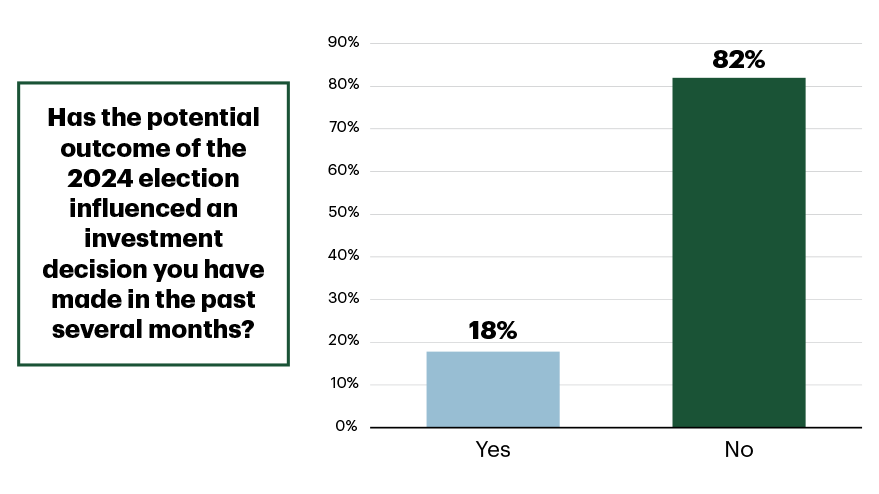
Source: Piper Sandler client survey (1,086 respondents, survey undertaken mid-March)
Stay tuned for more commentary as we inch closer to U.S election day.
Editor's Note: On July 21st President Biden announced that he will not seek re-election and endorsed Kamala Harris as the Democratic candidate for President. Kamala Harris’s candidacy was confirmed at the Democratic National Convention in August. Policy positions for Harris are likely to remain status quo and very similar to Biden’s.
¹ Pew Research Center survey of 12,693 adults conducted Feb. 13-25.
² Joe Biden, at 81, will be the oldest ever presidential candidate, while Trump will be 78. Since 1789 there have only been four cases where the president was age 70 or higher. Ten were in their forties, 35 in their fifties and 19 in their sixties.
³ Piper Sandler client survey, March 2024.
本文所含信息由道明资产管理有限公司提供,仅供参考。信息出自我们认为可靠的来源。本信息并未提供财务、法律、税务或投资建议。具体的投资、税款或交易策略应根据每位投资者的目标和风险承受能力加以评估。
本文档中的部分陈述可能包含预测性的前瞻性陈述(“FLS”),其中包含“预计”、“预期”、“打算”、“认为”、“估计”和类似的前瞻性表述或其否定形式。前瞻性陈述基于当前对未来普遍的经济、政治、相关市场因素(例如利率和汇率、股票和资本市场)以及普遍经营环境的预计和预测,并假定不发生税法或其他法律或政府管制方面的任何变动或灾难事件。对于未来事件的预计和预测本身受无法预见的风险和不确定性的影响。此等预计和预测可能在未来并不准确。前瞻性陈述并非对未来表现的保证。实际发生的事件可能与前瞻性陈述明示或暗示的事件存在实质差异。包括上文所述各项因素在内的多个重要因素均可能造成这种背离。您不应在任何程度上依赖于前瞻性陈述。
道明资产管理有限公司 (TD Asset Management Inc.) 是道明银行 (The Toronto-Dominion Bank) 的全资拥有附属机构。
® TD标志和其他TD商标为道明银行或其子公司的产权。


